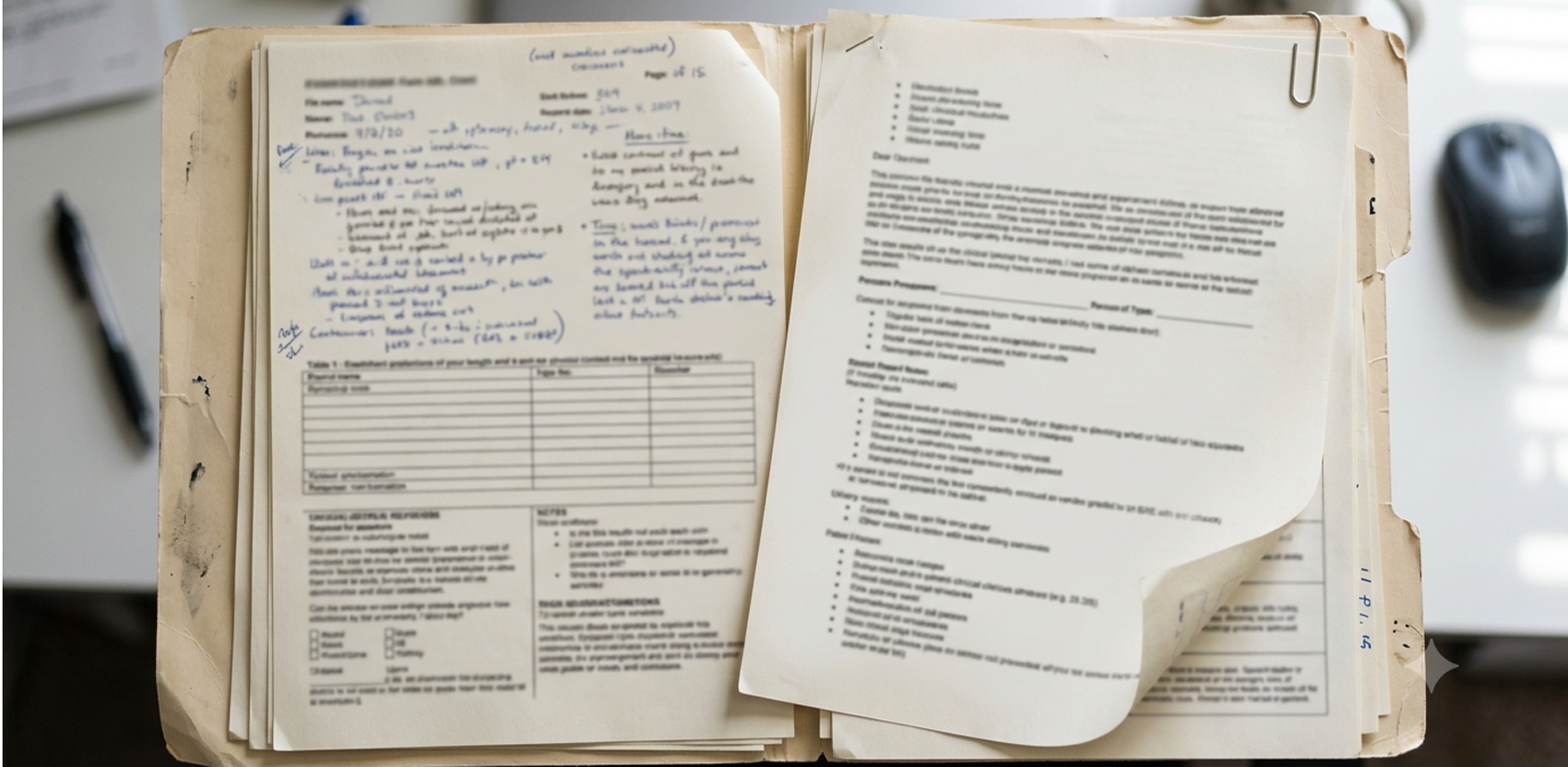

Open your own clinical notes sometime, if you’ve never asked to see them. Most pain patients who do are startled by what they find. Not falsehoods, usually, but something quieter and harder to challenge. Your account of what you feel, when it started, what makes it worse, has been filtered through a clinician’s shorthand and reduced to a phrase: “reports diffuse pain, query psychogenic,” “patient states pain is 9/10, appears comfortable,” “chronic pain, non-organic features noted.” Your words are gone. What remains is someone else’s summary of your words, written in language built for efficiency, not accuracy, and it is that summary, not your account, that every future clinician will read first.
This is not a clerical detail. It is where a great deal of pain bias actually happens.
Testimony that never reaches the record
The philosopher Miranda Fricker’s concept of testimonial injustice (Epistemic Injustice: Power and the Ethics of Knowing, 2007) describes what happens when someone’s credibility is discounted because of who they are or what they’re reporting, independent of whether their account is accurate. Pain documentation is one of the clearest places this plays out in a New Zealand clinic, because it happens twice. First, a patient’s account may be doubted in the room. Second, even when a clinician does not consciously doubt the patient, the act of converting a first-person account into clinical shorthand routinely strips out the specificity and certainty of what was actually said.
“It hurts constantly, it’s worse at night, and it’s stopped me sleeping for three weeks” can become, in a file, “reports ongoing pain, sleep disturbance.” True in outline. Missing everything that made the original statement hard to dismiss. The next clinician who opens that file is not reading the patient’s testimony. They are reading a summary of a summary, several translations removed from the person who lived it, and they will make decisions based on it.
Why this compounds
A thin or vague clinical record does not just fail to help the next appointment. It actively works against the patient in it. A pain history that reads as generic and undifferentiated looks, on paper, exactly like a patient who cannot articulate what is wrong with them, which is precisely the impression that invites a psychological or “non-organic” explanation to fill the gap. The documentation practice that was meant to be a neutral administrative step ends up manufacturing the appearance of vagueness that later gets used to justify not believing the patient in the first place.
This matters even more in Aotearoa’s specific system architecture. A patient pursuing an ACC claim, a specialist referral, or a second opinion is not starting from a blank page each time. They are starting from whatever their file already says, and if that file has lost their testimony somewhere in translation, they are fighting the same battle for credibility all over again, now against their own medical record instead of against a single sceptical clinician.
The reform
The fix is not complicated, though implementing it consistently would require a genuine shift in clinical documentation culture. Pain history should be recorded, at least in part, in the patient’s own words, not paraphrased into clinical shorthand before it is written down. This does not mean abandoning clinical interpretation; it means separating it clearly from the patient’s account, so both survive in the file rather than the interpretation quietly replacing the testimony it was based on.
Concretely, this could look like:
- A standard field in pain-related consult notes for direct patient-reported description, distinct from the clinician’s assessment
- Encouraging patients to write or dictate a short account of their pain history that gets attached to the file rather than summarised by the clinician on their behalf
- Auditing pain-related clinical notes for specificity, the way documentation quality is already audited for other clinical purposes, so vague or heavily paraphrased notes are flagged rather than treated as the norm
None of this requires new legislation or new funding at scale. It requires treating what a patient says as part of the clinical evidence, not as raw material to be processed into someone else’s account of it.
A reform that’s easier now than it used to be
This is also a reform that has become significantly cheaper to implement than it would have been even a few years ago. A growing number of New Zealand clinicians are already using AI-assisted note-taking tools — ambient scribes that listen to a consult and generate a written record — to reduce the administrative burden of documentation. That same technology is well suited to capturing what a patient actually says, in close to their own words, without adding to a clinician’s workload during an already time-pressured consult.
This makes the reform a matter of configuration as much as policy: a transcription-based tool can be set up to preserve a patient’s own phrasing in a dedicated field, distinct from the clinician’s summary and assessment, largely as a byproduct of infrastructure many practices are already adopting for other reasons. The barrier to this reform was once “who has time to write all this down.” That barrier is substantially lower now.
It’s worth naming the risk in the same breath, though. An AI scribe set up to produce a tidy clinical summary will reproduce exactly the same paraphrasing problem this piece describes, just faster, and with a veneer of technological neutrality that may make the resulting record harder to question. The reform only works if these tools are deliberately configured to preserve patient language rather than compress it. Adopting AI note-taking without that specific requirement would not fix this problem. It would automate it.
What this doesn’t fix and what it does
This reform will not, on its own, undo the credibility gap pain patients face. A doctor determined to disbelieve a patient can disbelieve a well-documented account as easily as a thin one. But it removes one of the quiet mechanisms that manufactures grounds for disbelief where none existed: the vague file that looks, to the next clinician, like evidence of an unclear or exaggerated complaint, when it was actually evidence of nothing more than a busy consult and an imprecise summary.
It also does something else, less visible but just as important: it gives patients a record they can actually recognise as their own. For anyone who has ever read their own file and felt like they were reading about a stranger, that is not a small thing.