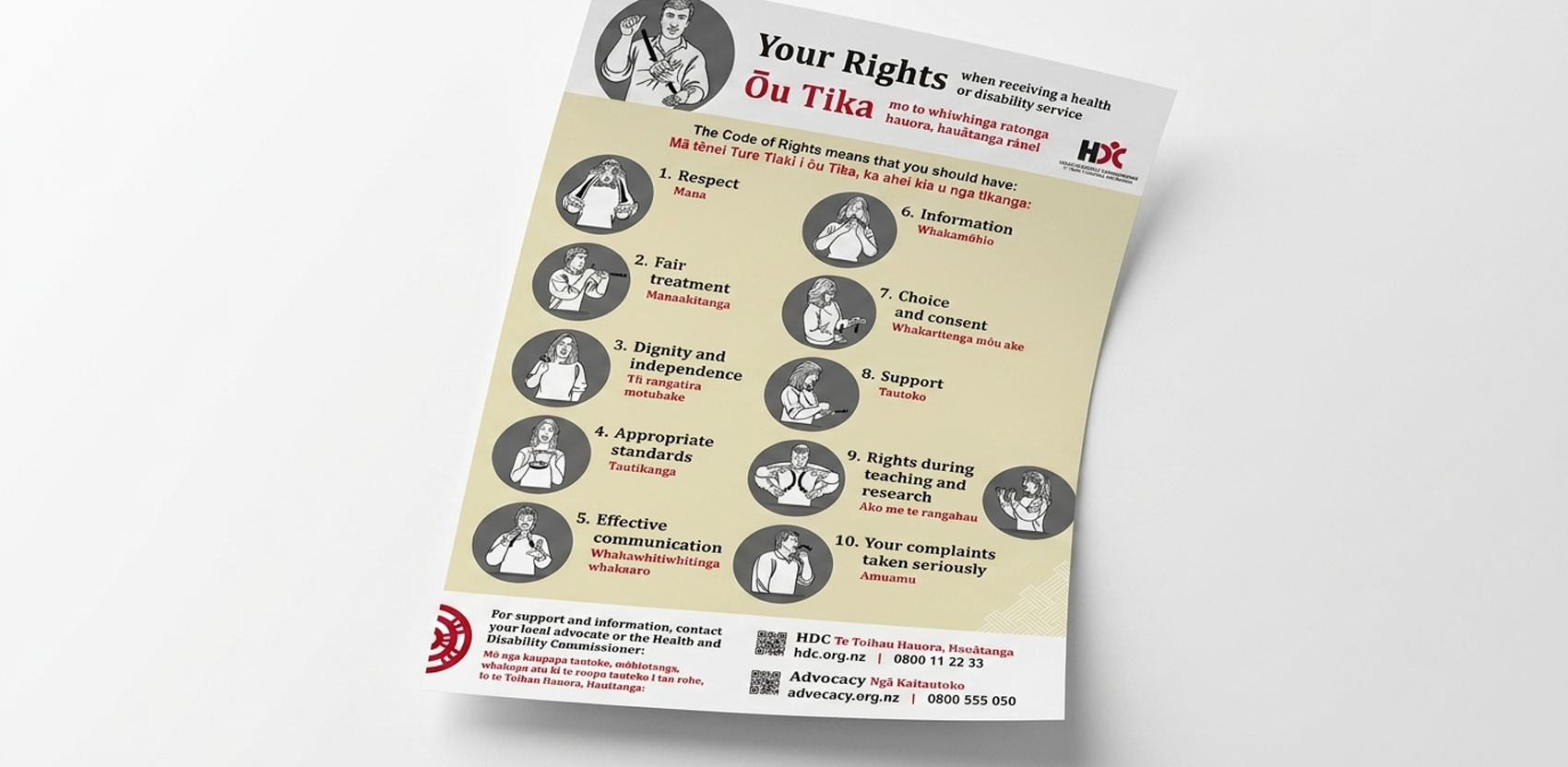

You do not need a lawyer, a diagnosis, or a completed ACC claim to have rights in a healthcare setting. If you are using a health or disability service anywhere in New Zealand, you are already protected by law, whether or not you have ever been told so.
That law is the Code of Health and Disability Services Consumers’ Rights, usually just called the Code. It became law on 1 July 1996 and grants a set of rights to everyone using health and disability services in New Zealand, placing corresponding obligations on the providers of those services. It sets out ten rights in total. It applies to anyone providing health or disability services, and providers have a duty to give effect to it.
Below is a plain-language walkthrough, weighted toward the rights most relevant to pain dismissal specifically. The full legal text is linked at the end if you want to read it directly.
The ten rights, briefly
Right 1: the right to be treated with respect.
Right 2: the right to freedom from discrimination, coercion, harassment, and exploitation.
Right 3: the right to dignity and independence.
Right 4: the right to services of an appropriate standard.
Right 5: the right to effective communication.
Right 6: the right to be fully informed.
Right 7: the right to make an informed choice and give informed consent.
Right 8: the right to support.
Right 9: rights in respect of teaching or research.
Right 10: the right to complain.
Most of these are self-explanatory once named. The ones below are worth slowing down on, because they come up again and again in pain dismissal specifically.
Right 3: Dignity and independence
This means you have a right to receive care in a manner that does not put you in an awkward or embarrassing situation, and that allows you to do as much for yourself as you are able to. Being spoken to as though your pain is exaggerated, an inconvenience, or a personal failing is not consistent with this right, even when nothing overtly rude is said.
Right 4: Services of an appropriate standard
You have the right to have services provided with reasonable care and skill, and to have those services comply with legal, professional, and ethical standards. You also have the right to have services provided in a way consistent with your needs, and to have providers cooperate with each other to ensure continuity of care. If you have been bounced between providers with no one taking responsibility for coordinating your care, this right is directly relevant.
Right 5: Effective communication
You have the right to communication in a form, language, and manner that allows you to actually understand the information given to you, and to an environment where you and your provider can communicate openly, honestly, and effectively. This applies to language barriers, but it also applies more broadly. If a doctor is speaking to you in a way that shuts down rather than opens up conversation, that is relevant here too.
Right 6 and Right 7: Being fully informed, and informed consent
You have the right to the information a reasonable person in your circumstances would expect, including an explanation of the options available to you, an assessment of the risks, benefits, and costs of each option, and how long treatment is expected to take. Before agreeing to any treatment, or declining one, you are entitled to enough information to actually make that decision, not just enough to comply with what is suggested.
Right 8: Support
You have the right to have a support person of your choice with you when you receive any health or disability service. This is not a courtesy a receptionist grants you. It is a right you can simply state at the time you book, or at the door of the appointment: “I’ll be bringing a support person.” No further justification is required.
Right 10: The right to complain
You have the right to complain about the care you receive, to have that complaint properly listened to, to know the complaints process, and to be told how it will be handled. A complaint is not an overreaction. It is a mechanism the Code itself sets up for you to use.
Where to go if a right isn’t being upheld
New Zealand has a free, independent service specifically for this. The Health and Disability Services Consumer Advocacy Service was established in 1996, operates independently from every health and disability provider, government agency, and the Health and Disability Commissioner itself, and is free to use. You do not need to have already tried and failed elsewhere before contacting them. You can call them before an appointment if you want to know your options, not only after something has gone wrong.
If you want to formally complain, that goes through the Health and Disability Commissioner (HDC). Our step by step guide to making an HDC complaint walks through exactly how that works.
A note on how the Code is meant to work
A provider is not automatically in breach of the Code simply because something went wrong. The test is whether they took reasonable actions in the circumstances to give effect to your rights, and the onus is on the provider to prove that reasonable action was taken, not on you to prove it wasn’t. That distinction matters. You are not required to build a case. The provider is required to show they met the standard.
In short
- You already have these rights. You do not need to ask permission to use them.
- Bringing a support person, asking for information in writing, and asking for a second opinion are not confrontational acts. They are things the Code specifically allows for.
- If something feels wrong in an appointment, the Advocacy Service is free, independent, and available before you escalate to a formal complaint, not only after.
Read the full Code of Health and Disability Services Consumers’ Rights on the Health and Disability Commissioner’s website.