
The model and what it holds
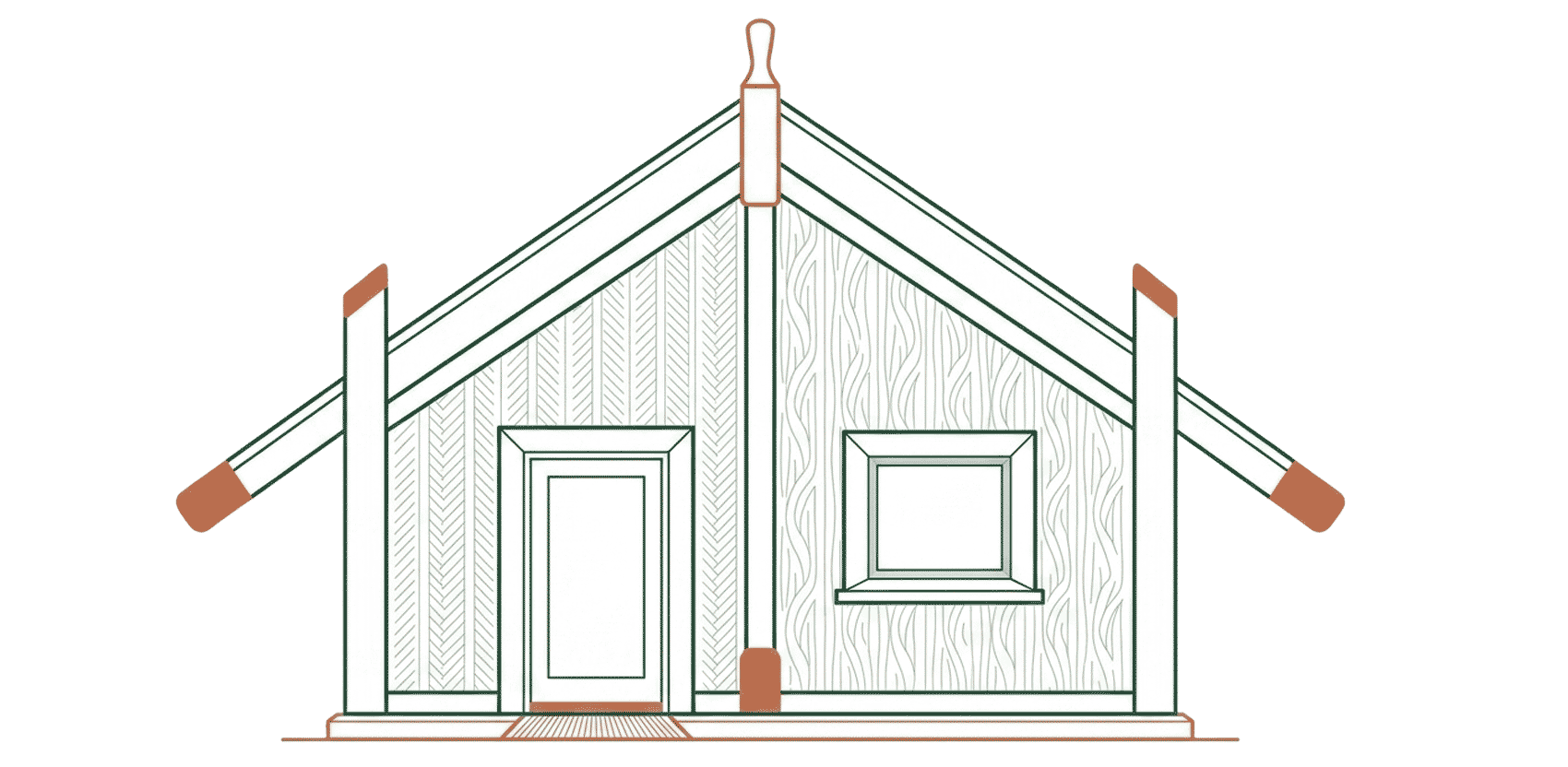
Te Whare Tapa Whā was developed by Sir Mason Durie in the early 1980s as a framework for understanding Māori health and, by extension, for understanding health in its fullest sense. The name translates as “the four-sided house.” The metaphor is structural: a house stands on four walls of equal importance, and if any one wall is weakened, the whole structure is compromised.
The four dimensions are:
Taha tinana — physical health. The body, its capacity, its functioning. This is the dimension that conventional biomedicine recognises and almost exclusively attends to.
Taha hinengaro — mental and emotional health. Thoughts, feelings, and the relationship between mind and body, understood not as separate territories but as inseparable aspects of a single person. Hinengaro encompasses not only the absence of psychiatric disorder but the whole of a person’s emotional and cognitive life.
Taha wairua — spiritual health. The dimension of meaning, connection to something larger than the individual self, a sense of purpose and place in the world. For many Māori, this includes connection to tūpuna (ancestors) and to the land. For others, it is experienced differently, but its presence or absence in a person’s life has tangible effects on wellbeing.
Taha whānau — family and social health. The relationships, community, and belonging that hold a person. Whānau in te reo Māori carries a broader meaning than the English “family”; it encompasses the web of relationships, obligations, and connections within which a person lives and has identity.
These four walls rest on a foundation — whenua, the land, the roots from which health grows — and the whole structure is understood as dynamic. Health is not a fixed state but a living one, responsive to what is happening in all four dimensions simultaneously.
Why this matters for pain
Persistent pain is, almost by definition, a condition that inhabits every wall of the house.
Taha tinana is the most obvious: the physical reality of a nervous system under sustained stress, of tissues that may or may not show damage, of a body that has reorganised itself around the experience of pain. But taha tinana is only the entry point.
Taha hinengaro is profoundly implicated. Persistent pain changes how people think: about themselves, about the future, about their capacity. It generates grief for the life that preceded it. It produces fear: of movement, of re-injury, of not being believed. It creates cognitive load that exhausts attention and memory. The relationship between pain and emotional health is not merely correlational; it is mechanistic. The nervous system does not distinguish cleanly between physical threat and psychological threat. Stress, fear, and hopelessness are not “reactions” to pain that can be neatly set aside; they are part of the pain experience itself, mediated by the same neural architecture.
Taha wairua is the dimension most systematically ignored in biomedical pain care, and its absence is felt. Persistent pain attacks meaning. It displaces the person from the roles and activities through which they understood themselves: as worker, parent, athlete, contributor. It raises questions about identity and worth that clinical appointments rarely have time or framework to address. A person who has lost their sense of purpose, who cannot see forward, who feels cut off from what made life meaningful: that person is suffering a wairua wound as surely as they are suffering a tinana wound. Attending to one without the other is incomplete care.
Taha whānau is both protective and, under pressure, a source of additional harm. Strong relational support is one of the most robustly documented protective factors in chronic pain outcomes. Isolation and disconnection reliably worsen them. But persistent pain strains relationships: it changes family dynamics, creates dependence, generates guilt, and can erode the social bonds that were sustaining the person. The whānau dimension of pain is not background context. It is clinical information.
The model the system uses instead
The dominant framework in pain medicine — and emphatically in ACC — is biomedical. It focuses on taha tinana almost exclusively, and when it gestures toward other dimensions, it does so in a way that distorts them.
The biopsychosocial model, developed by George Engel in the 1970s and now nominally adopted across much of pain medicine, appears at first glance to be doing similar work to Te Whare Tapa Whā. It acknowledges biological, psychological, and social factors. In principle, this is an improvement on pure biomedicine.
In practice, particularly in the context of compensation and assessment, the biopsychosocial model has been colonised by a specific interpretive move: psychological and social factors are introduced not to understand and treat the whole person, but to explain why the person’s physical presentation doesn’t match the expected picture. “Psychosocial factors” becomes a phrase that means the reason we are discounting your pain report. The model that was supposed to expand care narrows instead into a gatekeeping tool.
Te Whare Tapa Whā does not permit this move. Its four dimensions are not a hierarchy in which the physical sits at the top and the others serve to explain anomalies in it. They are equally real, equally worthy of attention, and equally capable of generating suffering in their own right. A framework that takes taha wairua seriously cannot dismiss a person’s collapsed sense of meaning as a complicating “psychosocial factor.” It must attend to that collapse directly.
The Treaty obligation that is not being met
New Zealand’s health system operates under Te Tiriti o Waitangi obligations. The Pae Ora (Healthy Futures) Act 2022 places explicit requirements on the health system to reduce health disparities for Māori and to give effect to Te Tiriti principles. The New Zealand Health Strategy has incorporated Te Whare Tapa Whā as a guiding framework.
These obligations are not decorative. They require that Māori are able to access health care that is culturally responsive, that health outcomes for Māori are equitable, and that Māori concepts of health, including holistic frameworks like Te Whare Tapa Whā, are integrated into how care is actually delivered.
For Māori with persistent pain, the current reality falls dramatically short of this. The evidence shows that Māori patients receive less adequate pain treatment, face greater clinical scepticism about pain severity, are less likely to be referred for specialist review, and are more likely to have their pain attributed to psychological or social causes without adequate investigation of the physical dimension. The very communities for whom Te Whare Tapa Whā was developed as a health framework are the communities most systematically failed by a system that claims to honour it.
This is not simply a problem of cultural competence at the individual clinician level, though that matters. It is a structural problem: an ACC system built on biomedical evidentiary standards, staffed largely by practitioners trained in Western clinical paradigms, assessing claims through a liability-management lens, in which a Māori patient presenting with complex persistent pain is facing multiple simultaneous sources of disadvantage. The Treaty obligation requires the system to address this. The system has not.
What the science says, and what that should not be used to mean
It is worth noting carefully that the current science of pain is substantially more compatible with Te Whare Tapa Whā than with pure biomedicine.
Research on central sensitisation, allostatic load, interoception, and predictive processing has established that pain is not a simple signal from damaged tissue but a whole-system experience shaped by the nervous system’s integration of threat information from every available source, including social, emotional, and experiential inputs. The evidence that isolation worsens pain, that meaning and purpose modulate pain, that the experience of being disbelieved produces measurable physiological stress responses… all of this coheres with a model that treats the social and spiritual dimensions of health as clinically real.
This convergence is real and worth acknowledging. But it should not be used to argue that Te Whare Tapa Whā is valid because Western science now endorses something like it. That framing inverts the proper relationship. A Māori health framework that has understood human beings as whole persons — physical, emotional, spiritual, relational — for generations does not require Western scientific validation to be taken seriously. The fact that the science has moved toward this understanding is a commentary on the limitations of the biomedical model that preceded it, not a retroactive grant of legitimacy to Indigenous knowledge.
The reason to hold both in view is not to collapse one into the other, but to observe that a health system which took current pain science seriously, and which honoured its Treaty obligations in substance rather than name, and which integrated Te Whare Tapa Whā as a living framework rather than a policy reference would look substantially different from the one we currently have and would serve people in pain far better.
What whole-health pain care would actually look like
If Te Whare Tapa Whā were actually applied to persistent pain assessment and treatment, several things would change.
Assessment would ask about all four dimensions from the beginning: not as a checklist, but as a substantive inquiry into how pain is affecting a person’s physical capacity, their emotional life, their sense of meaning and identity, and their relationships. This information would be used to understand, not to explain away.
Treatment would be truly multidisciplinary, integrating pain medicine, psychological support, social support, and attention to the meaning dimension, which might include creative work, reconnection to community, or for Māori patients, tikanga-informed approaches to wellbeing. The goal would not be symptom reduction alone but restoration of the person’s capacity to live a life that feels worth living.
The compensation system would understand that the harm done by persistent pain is not confined to physical damage. Lost whānau connection, collapsed vocational identity, spiritual desolation… these are real losses, deserving of recognition and support, not merely as “psychological” complications but as real dimensions of the injury being claimed.
Clinicians working with Māori patients in pain would be equipped — in supervision, training, and the design of their services — to understand that a whole-person framework requires attending to taha wairua and taha whānau as actively as to taha tinana. This is not a supplement to good pain care. It is what good pain care looks like.
The house that holds
The image of the house in Te Whare Tapa Whā is not incidental. Houses hold people. They are places of safety, of shelter from what is difficult outside. When any wall weakens, the whole structure is at risk — not because the other walls are inherently fragile, but because the load is redistributed in ways that no single wall was designed to bear alone.
Persistent pain is, among other things, a structural challenge to the house of a person’s health. It weakens walls that were strong. It exposes vulnerabilities that were previously protected. It requires that all four dimensions be attended to — not sequentially, not as an afterthought to the physical, but simultaneously, by a system willing to hold the full complexity of what a person is.
New Zealand has a framework that understands this. It was developed here, from within the epistemological traditions of tangata whenua. It is not a Western import requiring adaptation. It is already ours, already in the room.
The work is to actually use it.
Te Whare Tapa Whā was developed by Sir Mason Durie and first published in the New Zealand Medical Journal in 1985. It remains one of the most cited frameworks in New Zealand health policy. For more on Māori models of health and their relevance to chronic illness, see this resource library.
If you are Māori or Pasifika and have experienced compounded barriers to pain care, we want to hear your story. [Share your experience here.]